

March 5, 2013 — This essay was posted simultaneously at Scientific American.
Nothing dominates the American landscape like corn.
Sprawling across the Midwest and Great Plains, the American Corn Belt is a massive thing. You can drive from central Pennsylvania all the way to western Nebraska, a trip of nearly 1,500 miles, and witness it in all its glory. No other American crop can match the sheer size of corn.
So why do we, as a nation, grow so much corn?
The main reason is that corn is such a productive and versatile crop, responding to investments in research, breeding and promotion. It has incredibly high yields compared with most other U.S. crops, and it grows nearly anywhere in the country, especially thriving in the Midwest and Great Plains. Plus, it can be turned into a staggering array of products. Corn can be used for food as corn flour, cornmeal, hominy, grits or sweet corn. It can be used as animal feed to help fatten our hogs, chickens and cattle. And it can be turned into ethanol, high-fructose corn syrup or even bio-based plastics.
No wonder we grow so much of the stuff.
But it is important to distinguish corn the crop from corn the system. As a crop, corn is highly productive, flexible and successful. It has been a pillar of American agriculture for decades, and there is no doubt that it will be a crucial part of American agriculture in the future. However, many are beginning to question corn as a system: how it dominates American agriculture compared with other farming systems; how in America it is used primarily for ethanol, animal feed and high-fructose corn syrup; how it consumes natural resources; and how it receives preferential treatment from our government.
The current corn system is not a good thing for America for four major reasons.
The American Corn System Is Inefficient at Feeding People. Most people would agree that the primary goal of agriculture should be feeding people. While other goals — especially producing income, creating jobs and fostering rural development — are critically important too, the ultimate success of any agricultural system should be measured in part by how well it delivers food to a growing population. After all, feeding people is why agriculture exists in the first place.
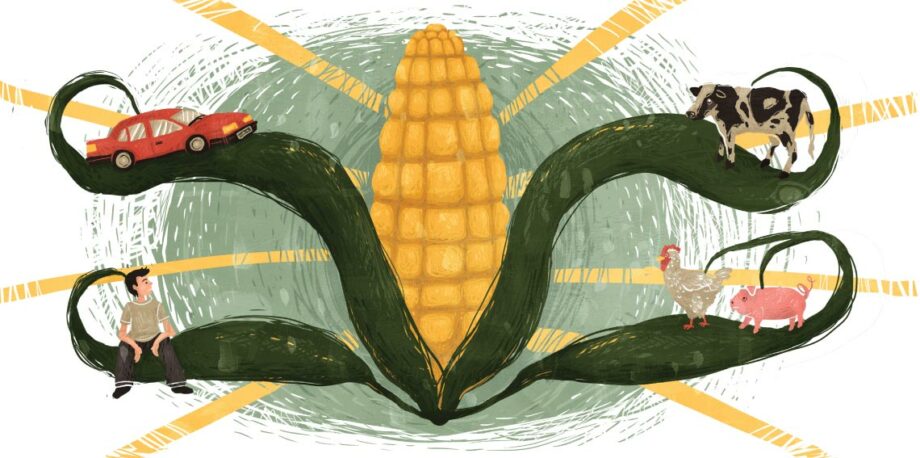
The corn system is aligned to feed cars and animals instead of feeding people.
While U.S. corn is a highly productive crop, with typical yields between 140 and 160 bushels per acre, the resulting delivery of food by the corn system is far lower. Today’s corn crop is mainly used for biofuels (roughly 40 percent of U.S. corn is used for ethanol) and as animal feed (roughly 36 percent of U.S. corn, plus distillers grains left over from ethanol production, is fed to cattle, pigs and chickens). Much of the rest is exported. Only a tiny fraction of the national corn crop is directly used for food for Americans, much of that for high-fructose corn syrup.
Yes, the corn fed to animals does produce valuable food to people, mainly in the form of dairy and meat products, but only after suffering major losses of calories and protein along the way. For corn-fed animals, the efficiency of converting grain to meat and dairy calories ranges from roughly 3 percent to 40 percent, depending on the animal production system in question. What this all means is that little of the corn crop actually ends up feeding American people. It’s just math. The average Iowa cornfield has the potential to deliver more than 15 million calories per acre each year (enough to sustain 14 people per acre, with a 3,000 calorie-per-day diet, if we ate all of the corn ourselves), but with the current allocation of corn to ethanol and animal production, we end up with an estimated 3 million calories of food per acre per year, mainly as dairy and meat products, enough to sustain only 3 people per acre. This is lower than the average delivery of food calories from farms in Bangladesh, Egypt and Vietnam.
In short, the corn crop is highly productive, but the corn system is aligned to feed cars and animals instead of feeding people.
There are a number of ways to improve the delivery of food from the nation’s corn system. First and foremost, shifting corn away from biofuels would generate more food for the world, lower demand for grain, lessen commodity price pressures, and reduce the burden on consumers around the world. Furthermore, eating less corn-fed meat, or shifting corn toward more efficient dairy, poultry, pork and grass-fed beef systems, would allow us to get more food from each bushel of corn. And diversifying the Corn Belt into a wider mix of agricultural systems, including other crops and grass-fed animal operations, could produce substantially more food — and a more diverse and nutritious diet — than the current system.
The Corn System Uses a Large Amount of Natural Resources. Even though it does not deliver as much food as comparable systems around the globe, the American corn system continues to use a large proportion of our country’s natural resources.
Ensia shares solutions-focused stories free of charge through our online magazine and partner media. That means audiences around the world have ready access to stories that can — and do — help them shape a better future. If you value our work, please show your support today.
Yes, I'll support Ensia!
That appears to be better than feeding the corn to livestock, which only provides food for 3 people (who can't go to the store for food, because they're out of gas).
Oh, and animals actually DO eat corn and DDGs. So, there's that . . .
As much as it might sound like a good plan to you, I'm not sure I want the U.S. to start adopting the food delivery strategy of Vietnam, Egypt, and Bangledesh.
You're right when you say that when we turn corn into ethanol, the distillers grains (DDGs) that are left over are fed to livestock, which gives additional benefits from that corn.
In fact, this is already accounted for in the calorie conversions mentioned in the essay. So the overall loss of 80% of the calories coming off a corn field -- the biggest losses due to inefficiencies of any major agricultural system on earth -- are still there.
The biggest issue is that growing a crop that is intended for fuel and feed (with an average efficiency of converting calories from corn to meat and dairy of between 3-40%), not human food directly, is never going to be efficient at providing food to the world. It's just math and physics, I'm afraid.
Bottom line: corn is a highly productive crop, but the system it's used in right now in the US is extremely inefficient at actually feeding anyone.
So often the naive wishfully think, "If only farmers could raise organic food crops on their acres to sell locally." Unfortunately they misunderstand the scale, the supply and demand, the pricing, and the logistics of such thinking. Can you imagine the waste?
Values that include sustainability, care for future generations, and thinking beyond the almighty dollar are needed for the systemic change. In the world of business....in the United States of America....that is no small ask.
Something of value must be produced from the land and that land, as natural capital, must be maintained for productivity to remain or improve. Most American farmers are not soil ecologists - they know their ground, but they don't know their soil.
Our problem is not too much corn for the sake of too much corn, but because it is impossible to plant 100m acres of corn year after year and properly manage our natural capital. We could get a lot closer to better management with some tweaks to the system, but that would take something akin to ecocommerce; a natural capital valuation. Without ecocommerce, such as a governor on an engine, our agriculture system looks similar to what happens when you make a streak across a well-nourished petri dish - you go until you don't.
But unless you are preaching for a vegetarian world, feed is still much more efficient than pasture to convert these pounds of corn and soybeans into pounds of meat. Maybe we should work also on the type of meat, with chicken being the most efficient at this conversion, and beef the least.
My hope with this essay was to generate some more thinking and discussion. In that way, I hope that it was helpful.
What would feed the animals? And what would the source of the ethanol be? The PLA plastic? and so on.
I'm not saying it's a bad idea to re-work the mix. But wouldn't some of that just get shifted to some other monoculture (like Brazil does sugar cane for sugar and ethanol, or such)?
"This isn't absolutely fair, because (at least in your summary) it counts non-food agricultural acreage as food acreage. It's as if you lumped sustainably managed forests together with fruit and nut orchards and complained about the low productivity of apples...."
http://www.motherjones.com/tom-philpott/2013/03/corn-domiated-us-agriculture-less-efficient-bangladeshs#comment-826898983
That struck me as a pretty good observation too.
In terms of systems…. The American corn farmer averages about 130-140 pounds of nitrogen fertilizer/acre, which has not changed since about 1975. The last USDA data shows 140 #/A for 2010, a year Minnesota farmers used 125 #/A. What happened to yields during that period? Yields increased from about 90 bu/A to over 155 bu/A, at least a 70% increase, without an increase of applied exogenous nitrogen. Farming technologies are not static, nor are genetics and breeding, biology, technology and engineering, and most critically, the economics of farming. How did the farmer change and contribute to the dramatically increased efficiency of the system? This period marked the beginning of innovative, revolutionary changes in practices such as reduced/minimum/no tillage resulting in dramatic decreases in (mostly, then) non–renewable fossil fuel burned/acre, soil compaction, total social cost, etc. Why? The evolution was driven by the development of sustainable approaches and engineering advances coupled with near-total adoption by the farmer, resulting in increased preservation of natural resources, minimizing irreversible losses. The evolution was also driven by the desperation of steadily increasing costs and unchanged commodity prices because of simple supply-demand factors. The singular major cause of the exodus of perhaps 70% of farm populations in the Midwest-Great Plains in the last 100 years.
In 2012 Minnesota lead the nation in corn yield with 165 bu/A. Associated is the fact that about 2.3 ton/A of corn residue was returned to soil, in contrast to about 0.8 T/A returned in 1962, when I was exiled from our Minnesota farm. The difference is 1.5 T/A, and in 1962 we incorporated residue with the now-rare moldboard plow. In 2012, with minimum tillage and resultant decreased “burst” of fall decomposition and loss of CO2, nitrous oxide and other volatiles, these practices contribute to soil organic matter sustainability. Subsequent decomposition, accelerating during the next growing season, remarkably coincides with maximum physiological demand of major elements. These continually evolving practices contribute to enhanced soil conservation.
Technical deletions/errors? Acreage? Apparently 97 million acres in 2012, which would surpass the 1944 level of 95.475 MA, and within reach of 100 MA, which characterized corn production most of the 1930s, reaching a maximum of 113 MA in 1932. And, 13 million acres added, 2006-2011? Why not use current data: 2007-2012, 3.5 MA?
Decrease beef, increase poultry? Per capita beef consumption peaked in ca. 1978, and per capita chicken consumption passed beef sometime in the last five years.
And the numbers? Only 4.1% is used for HFCS. A “primary” use? In 2011 27.3% was used for ethanol, not "roughly 40%", because about 12% is returned to the food chain. This is the embryo, full of protein and oil. The endosperm is the source of starch for fermentation. Thus perhaps we could say that 48% of protein and 36% of corn starch of the US corn crop is used for animal production? Which becomes chicken, beef, pork, turkey, and, fish via aquaculture, i.e., food.
But, first of all, all PNAS articles are peer-reviewed by an extremely rigorous process.
Second, ethanol plants do take up 40% of the corn crop that's harvested, but then do return the distillers grains as animal feed. We take that into account in our calorie calculations, as stated in the essay.
The rest, not sure what these numbers are supposed to mean. Corn gained about 13 million acres since 2006 (same time period as PNAS study in question), mostly by taking up other farmland.
I certainly agree with Dr. Foley’s assessment that corn is a most productive and versatile crop. Such productivity comes from two inherent features of the species. First, crops have either a small photosynthetic engine (called C3) or a large photosynthetic engine (called C4). Wheat, rice, and soybean have the C3 engine but corn has been endowed with the bigger and better C4 engine, thus enabling it to produce higher yields. Second, hybrid vigor—the superiority of a hybrid over its parents—is much more pronounced in corn than in other crop species, thus allowing further boosts in yield from the growing of hybrid varieties. It's therefore no surprise that this native American species that we know as corn has dominated the U.S. agricultural landscape.
Just for food? Dr. Foley's article correctly points out that only a small portion of the nation’s corn crop is directly consumed by people, and that most of the grain is used to make fuel ethanol or to feed animals to produce food indirectly. Given that corn is a grass species, I could argue that corn-fed cattle are actually also grass-fed. Semantics aside, the crux of Dr. Foley's main argument is that the benefits of agriculture are to be measured only in terms of food produced, that "In short, the corn crop is highly productive, but the corn system is aligned to feed cars and animals instead of feeding people."
I must disagree that the value of any crop is to be measured only in terms of food produced. If this were so, then cotton would have no value whatsoever as a crop species. My area of expertise, plant breeding, is defined as the genetic improvement of plants for human benefit and this broad criterion of "for human benefit" must likewise be used to evaluate the value of any crop production system.
Too much corn? An underlying theme in Dr. Foley’s essay is that American farmers are producing too much corn for the wrong purposes. Yet as Dr. Foley correctly noted, America’s corn farmers are simply responding to market demand, and we cannot and should not fault farmers for simply producing what consumers want and what is profitable to grow. It is too easy to suggest that corn farmers should diversify and plant other crops—I still remember a U.S. presidential candidate telling corn and soybean farmers in Iowa to grow Belgian endive instead. Farmers already take much risk each year in planting crops that are subject to the uncertainties of cold or heat or drought or flood or diseases or insects or weeds, and a farmer would be crazy to add the risk of growing something that few consumers will buy or that would not grow well on one's farm.
Now let's suppose that consumer preferences change and Americans begin eating less bread and more food-grade corn, or less beef and more poultry and pork, or less meat and more vegetables. Or let's suppose that less ethanol becomes needed because Americans begin to drive fewer gas-powered cars and walk, bike, or take the city bus more. I would suspect that if consumer preferences change so that we eventually have less demand for #2 yellow dent corn, American farmers would by necessity be flexible in deciding what crop or crops they would need to grow so that their farming would remain profitable and sustainable.
My point is that the American consumer ultimately decides, via the pocketbook, what crops farmers produce and how they produce them. Do we want food that is affordable because of efficient monocultures of different crops in different places, or do we as consumers place a greater value on how the food is produced? I grew up in a country where crop and animal production systems were highly diversified due to the nature of the land and water, but where the grocery bill was about 40% of household income. While I cannot speak for others and do not impose my preference on others, I prefer my current grocery bill in Minnesota. And while some consumers prefer local or organic food, I'll take beef from corn-fed Nebraska cattle, blue cheese from Wisconsin, and a glass of Carménère wine from Chile’s Central Valley anytime.
A vulnerable house of cards? Fields of corn may look monolithic. Yet the corn varieties grown by farmers across the U.S. Corn Belt are quite diverse and this diversity has helped the corn crop survive whatever nature has thrown at it during the past 75 years of hybrid corn production. Dr. Foley wrote "Given enough time, most massive monocultures fail, often spectacularly." This is simply untrue in modern times. Yes, the Irish potato famine in the 1840s to 1850s led to hunger, suffering, and mass emigration. Yet corn has succumbed to an epidemic only once in the last 75 years. This occurred in 1970 when the wide use of T-cytoplasm for producing hybrid corn made the crop susceptible to a race of the southern corn leaf blight disease. Corn breeders learned a valuable lesson from this rare incident and have since refrained from using a common genetic background over a wide scale.
American farmers have obviously figured out what can be grown profitably in different parts of the country: corn and soybean in the Midwest; wheat in the Great Plains; rice in the delta region and California; vegetables in California; apples in Washington, New York, and Michigan; potatoes in Idaho; and canola and oat in, well, Canada. It is more efficient and less costly to grow
corn in southwest Minnesota and tomatoes in California than to grow both crops on the same farm in the same year in each of these two places. This point about performance versus diversity brings to mind a 1980s Farm Journal photo ad of an interesting dog sled team: the dogs pulling the sled included a bulldog, Dalmatian, Dachshund, Saint Bernard, and Chihuahua. We could argue that a diversified cropping system that includes row crops and orchards and grazing lands and prairies is better for the environment, but are we as consumers willing to pay much higher prices at the grocery store?
Diversity is certainly a hedge against unknown risks. But when the general risks can be anticipated, it is better to have crop varieties bred to withstand such perturbations than to have untargeted diversity. We cannot predict if cold or heat or drought or flood or diseases or insects will come in the next growing season, yet today’s high-performing corn hybrids have been bred so that they will not spectacularly fail should any of these stresses come.
Looking to the future: Corn monoculture is not without its limitations and much progress has been made over the years on two fronts: (1) genetically improved hybrids that are more productive, require less water and nitrogen, and are better able to withstand heat, cold, insects, and diseases; and (2) crop production practices and technologies that lead to better soil preservation and less nutrient runoff. With an eye towards the future, University of Minnesota agronomists have been investigating the use of cover crops and living mulches in corn production, while also being cognizant that adoption of cover crops or living mulches for corn depends on the ability to maintain profitability. I hold American farmers in the highest esteem as they continue to work the land to produce corn that meets all kinds of human needs. My hope is that the scientific research that my colleagues and I do at a land-grant university is meaningful and beneficial to those who produce this most wonderful native American crop.
-Rex Bernardo
Professor and endowed chair in corn breeding and genetics, University of Minnesota
When you recommend a shift in human meat consumption from beef to chicken, I immediately think of your groups' global maps that show direct production of human calories is high from rangeland in the west and low from cropland in the mid-west.
Could it be more efficient to stick with beef - if it is raised on land that is not suited for crops?
Chickens and hogs produce large amounts of nutrients with N:P ratios that are not suitable for direct crop uptake. This makes chicken and hog manure management a significant challenge, and as you know, much of their manure is wasted.
In contrast, beef still spends significant time at pasture and produces manure with N:P ratios that generally match crop demand (although the low concentration does make application more costly).
Beef production also encourages some diversity in the cropping system.
I am interested to hear your thoughts on this,
Mike Castellano
You're starting with a flawed premise, there, though. Most people would agree that the primary goal of agriculture is to produce useful products - biofuels and feed for animals are both as useful as feeding humans, aren't they? I don't follow why agricultural activities need to be narrowly targeted to feeding humans. Is this some sort of moral argument about prioritizing people?
With the current population increase, the primary goal of growing human food becomes even more important. Livestock such as cattle that wastes 5-10 pounds of feed to produce a pound of meat are already becoming luxuries and beef consumption has been decreasing for decades. Fish and chicken farming that converts 1-2 pounds of feed into 1 pound of meat are much more efficient.
As for biofuels, corn is terribly inefficient for ethanol. The bloody thing does not even contain sugar! You need to convert the starch into sugar first, then the sugar into ethanol. Sugar beets yields much more ethanol per acre than corn, they even yield more than sugar cane. All the ethanol in France is made from sugar beets, for instance.
I support all that Foley wrote in this article, it matches everything I know about American farming and corn, including the worrisome increasing loss of the Conservation Program lands. I would however like to stress that farmers are mostly the victims here, their participation in the "corn system" is mostly the result of the consumer demand, so, us and everybody else, and the influence of the farm and food industry lobbies, banking system (loans require crop insurance), and even to a certain degree, the education system.
Most of our food is imported from thousands of miles, like Chile, and is not seasonal anymore. I read yesterday that there is some sort of a deal to export American chickens to China for processing, and reimport the processed chickens into the U.S. Why is it that corporations are allowed to make profits at the cost of the jobs and the economy?
I would much rather see more diverse farming, and more food instead of feed in local farms. Growing food requires a lot of workforce, it's a great source of local employment, whereas a no-till farmer will spend maybe a week on a quarter section, like a day for fertilizing, one for planting, three for pesticides or dressing (more fertilizer), one for combining.
Another thing that needs to happen imperatively is irrigation: For me, it is almost immoral to grow crops in the dry lands. The U.S. ranks for instance in the 50s worldwide for wheat production because most of it is dryland wheat. Irrigation makes all the difference between one and three times the yield in a normal year, ten times in a drought year (for corn at least).
Of course, most lands don't have irrigation because there is no sustainable water source available. I was wondering how solar powered desalination plants could help, providing fresh water all alongside the coasts, and maybe even helping replenish some of the aquifers, while counteracting the ocean level rise a bit if performed on an industrial scale. It means we would need to farm only one third of the current acreage for the same production, and it opens some options like more grass fed or free range animals, fallowing or growing cover crops to help restore the soil humus, more diverse flowers to help the honeybees recover, etc. Just an idea.
There is also well known abuse by large estate owners. Many do make millions from crop insurance alone, I don't think that is how it was supposed to work.
The government mandate is to cover a certain percentage of the crop insurance, and also, if that tax-payer money and the money coming from the insurance companies do no cover what it was supposed to cover, like in last year's drought, the government adds even more tax-payer money to make it up. It might be a good thing to reserve the role of the government to covering this part during catastrophic years, but let the insurance companies handle the regular crop insurance.
Personally, I would rather favor getting rid of the insurance companies altogether, they are only leeches using the farmers as forced cash cows, and have it replaced by a fully automated system (that works a bit better than the U.S. healthcare web site). There are already tons of controls on the farms, it shouldn't be difficult to have one of these controllers to assess yields, or cross-reference county and private yields and elevator sales to establish the cost of the premiums, how much to pay back, etc.
A single crop insurance could also limit the total amount paid to avoid accounting tricks such as rotating crops around counties to get some crop insurance every year. There should also be penalties for the farmers abusing the systems in other ways, like planting but not side-dressing or adding pesticides or fertilizers, because all they want from this field is the crop insurance, not the bother of cultivating and harvesting it. These practices are bad stewardship. Thankfully the vast majority of farmers are decent, if a bit on the ultra-conservative and Christian fundamentalist side, but good ethics on the professional side: http://talk.newagtalk.com/forums/thread-view.asp?tid=428671&mid=3429636#M3429636
Many years ago, my discussions with my dad would at times have him upset about "how my taxes pay for the farmers vacationing in Florida for three months during the winter". He was watchful as well.
At some point, American farmer's can just stop growing corn for human consumption, and just go with all the other uses. Then, we will import corn from other countries. Yes corn has become very political. Bail outs, insurance, minimums per basket, and fallow ground requirements have made the kernel very political. Should we use 80 % of the corn fields for human consumption, Yes! Will we? No. Not until there is a major food disaster. Although some say there already is, with 60% of Americans being obese; and they are not eating corn, as this article illustrates.